
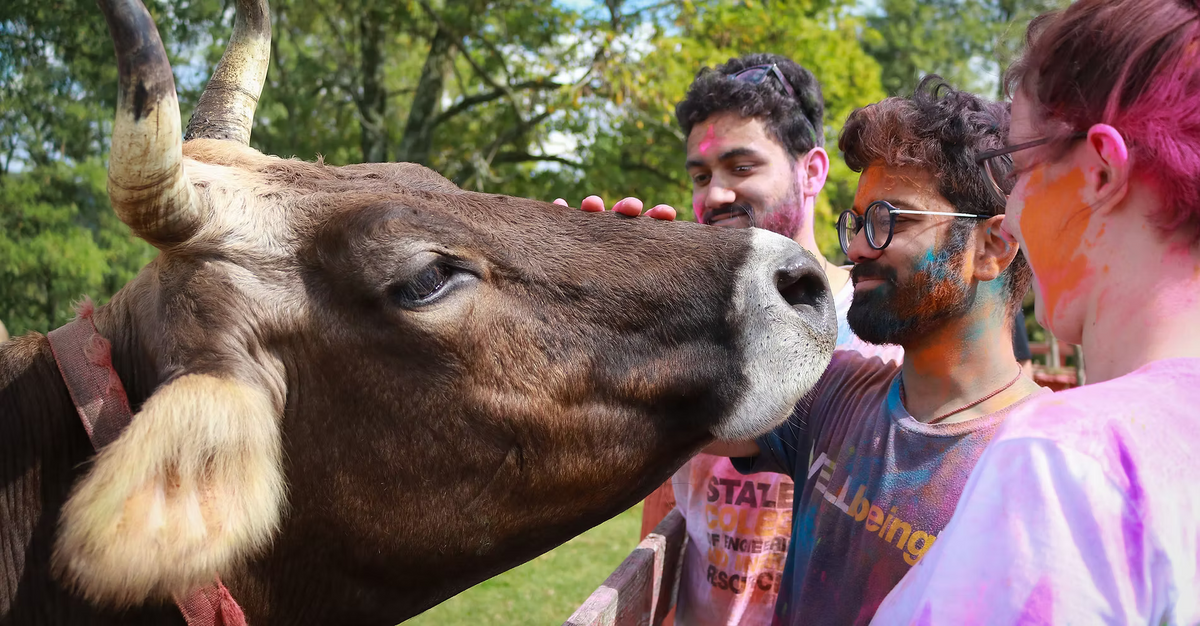
In the stories of Krishna's childhood in Vrindavan, cows are never far from the scene. They move through the pastures alongside Him, accompanied by His brother Balarama and their cowherd friends. Their presence is so familiar that it can be easy to overlook an important detail: caring for the cows was part of Krishna's daily life.
One festival brings this relationship into particular focus.
Gopastami, also spelled Gopashtami, celebrates the occasion when Krishna and Balarama, having previously tended young calves, began caring for the grown cows of Vrindavan. For followers of Krishna, the festival recalls a cherished moment in His childhood pastimes. It also offers an opportunity to explore why cows hold such an important place in Vaishnava devotional life and how this relationship continues to shape communities today.
What Is Gopastami, and Why Is It Celebrated?
Gopastami is observed on the eighth lunar day (ashtami) of the waxing fortnight of the Hindu month of Kartika, generally falling in October or November. According to Vaishnava tradition, Krishna and Balarama reached an age when the cowherd community considered them ready for a new role. Until then, they had cared for calves. Now they could accompany their friends into the pastures with the grown cows. This transition is described in the Śrīmad-Bhāgavatam (10.15.1), which recounts how the cowherd men entrusted Krishna and Balarama with tending the cows as they entered the stage of childhood known as paugaṇḍa.
The significance of the moment is not simply that two boys were growing older. Within the devotional understanding of Krishna's life, it marks another expression of His close relationship with the people, animals, and landscape of Vrindavan. Krishna is worshipped as the Supreme Lord in Gaudiya Vaishnavism, yet the sacred narratives also portray Him taking part in the ordinary activities of a cowherding village. He walks with His friends, tends the animals, and returns home from the pastures. These seemingly simple activities are understood by devotees as divine pastimes, or lila, through which Krishna reveals His affectionate relationships.
Gopastami commemorates that world of shared life, friendship, and devotion.
Krishna and the Cows of Vrindavan
Vrindavan, in the region of Braj in northern India, occupies a central place in Krishna devotion. In the sacred narratives, its forests, pastures, rivers, and villages provide the setting for His childhood pastimes.
Cows are woven throughout these accounts.
Krishna is frequently called Gopala, a name associated with His role as a protector or caretaker of cows. Another familiar name, Govinda, carries several traditional interpretations, including associations with cows and the joy He gives them. These names are more than reminders of an occupation. For devotees, they express something personal about Krishna's identity and His relationships.
The Śrīmad-Bhāgavatam describes Krishna and Balarama entering the forest with their cowherd companions and the animals entrusted to their care. The setting is pastoral, but the devotional meaning extends beyond the landscape itself. Krishna's companions do not relate to Him only through formal worship. They share friendship, play, work, and affection. The cows, too, belong to this intimate world of Vrindavan. Within Gaudiya Vaishnava theology, these relationships are understood as expressions of divine love rather than merely episodes from rural life.
For readers encountering these traditions for the first time, this helps explain why images of Krishna playing His flute among cows are so recognizable. The animals are not incidental decoration. They belong to the religious understanding of Krishna's life in Vrindavan.
Why Are Cows Respected in Vaishnava Traditions?
The question of why cows are considered sacred in Hinduism does not have one answer that applies equally to every Hindu community.
In many Hindu traditions, cows are treated with particular reverence. Their importance has religious, cultural, and historical dimensions, including their place in agricultural households and their association with nourishment.
Within Krishna-centered Vaishnavism, their significance is especially connected to Krishna Himself. Because cows are closely associated with His pastimes, honoring them can become an expression of devotion. The Sanskrit term go-seva means service to cows. In communities that practice cow protection, this service may include feeding, sheltering, grooming, and attending to the animals' health.
Historically, cows provided milk while oxen contributed agricultural labor. Their importance in rural life helped shape the cultural and religious relationships between people and cattle. Within Vaishnava devotional traditions, however, their significance extends beyond these practical contributions.
Cows are also associated with Krishna's beloved Vrindavan, making them an enduring presence in devotional art, literature, temple life, and religious festivals.
How Is Gopastami Celebrated?
Gopastami observances vary across temples, regions, and families, but honoring cows is a central feature in many Krishna-devotional communities. At temples and cow shelters, devotees may clean and groom the cows, decorate them with flowers, and offer food appropriate for the animals.
Some communities perform go-puja, a ceremony of worship honoring cows. Prayers, devotional singing, and offerings may accompany the occasion. In parts of Vrindavan, devotees also observe traditions associated with Krishna's cowherding companions and the wider community of Braj. These celebrations bring the stories of Krishna into a shared religious experience.
Visitors may encounter cows being carefully brushed, fresh fodder being prepared, or devotees gathering to sing and pray. The particular activities depend on the community and the animals' needs. For participants, these gestures recall Krishna's affection for the cows of Vrindavan and express gratitude for their place in devotional life.
Cow Protection at New Vrindaban, West Virginia
The relationship between Krishna and cows is not remembered only in India. In the hills of West Virginia, New Vrindaban has developed its own tradition of cow protection as part of a community dedicated to Krishna devotion. Founded in 1968, New Vrindaban takes its name and spiritual inspiration from Vrindavan, India. Its early development was guided by the teachings of A. C. Bhaktivedanta Swami Prabhupada, the founder of the International Society for Krishna Consciousness (ISKCON).
Cow protection became part of the community's work in 1969. At the New Vrindaban Goshala, cows are cared for as part of a continuing devotional commitment. The community's approach includes looking after older animals that no longer produce milk, as well as caring for calves and bulls. This reflects a central principle of go-seva: cow protection is a responsibility that continues throughout an animal's life, not only while it provides milk or agricultural labor.
New Vrindaban also maintains a dairy tradition, and its official cow protection program describes milk being offered in temple worship.
For visitors, the goshala provides an opportunity to encounter an aspect of Vaishnava practice that might otherwise remain familiar only through stories, paintings, or festival celebrations. The connection to Gopastami is especially direct. The festival remembers Krishna taking charge of the cows of Vrindavan, while New Vrindaban offers a contemporary example of cow protection rooted in the same devotional tradition.
The landscape is different, and so are the circumstances. Yet the religious inspiration remains connected to Krishna's pastoral pastimes.
What Gopastami Can Teach Us Today
Gopastami can be appreciated as a cultural festival, a religious observance, or an introduction to the relationship between people and animals in Vaishnava life. For devotees, its significance begins with Krishna. His role as a cowherd is part of His divine identity and a source of affection and remembrance.
For readers less familiar with the tradition, the festival offers a window into a distinctive aspect of Hindu religious culture: the way sacred narratives influence the treatment of animals, the organization of communities, and the meaning of everyday activities. The stories of Krishna in Vrindavan are filled with familiar scenes—friends walking together, animals grazing in the fields, and families welcoming the cowherd boys home.
Yet within Gaudiya Vaishnava theology, these scenes carry profound spiritual meaning. They portray relationships with Krishna that are intimate, affectionate, and deeply personal. Gopastami invites participants to remember that world and the place cows occupy within it.
At New Vrindaban, visitors can encounter this tradition not only through temple worship and devotional images but also through the community's goshala. For those who feel a connection to Krishna's cowherding pastimes, Matchless Gifts, the New Vrindaban Gift Shop, offers a collection of cow-themed devotional and decorative items inspired by this tradition. Explore our cow-themed collection and enjoy 15% off for a limited time. The discount is already applied, so no code is required.
But the deepest connection to Gopastami is not found in an object or a single celebration. It is found in the affectionate relationship between Krishna, His cowherd companions, and the cows of Vrindavan—a relationship that continues to inspire devotion, gratitude, and service in Vaishnava communities around the world.