
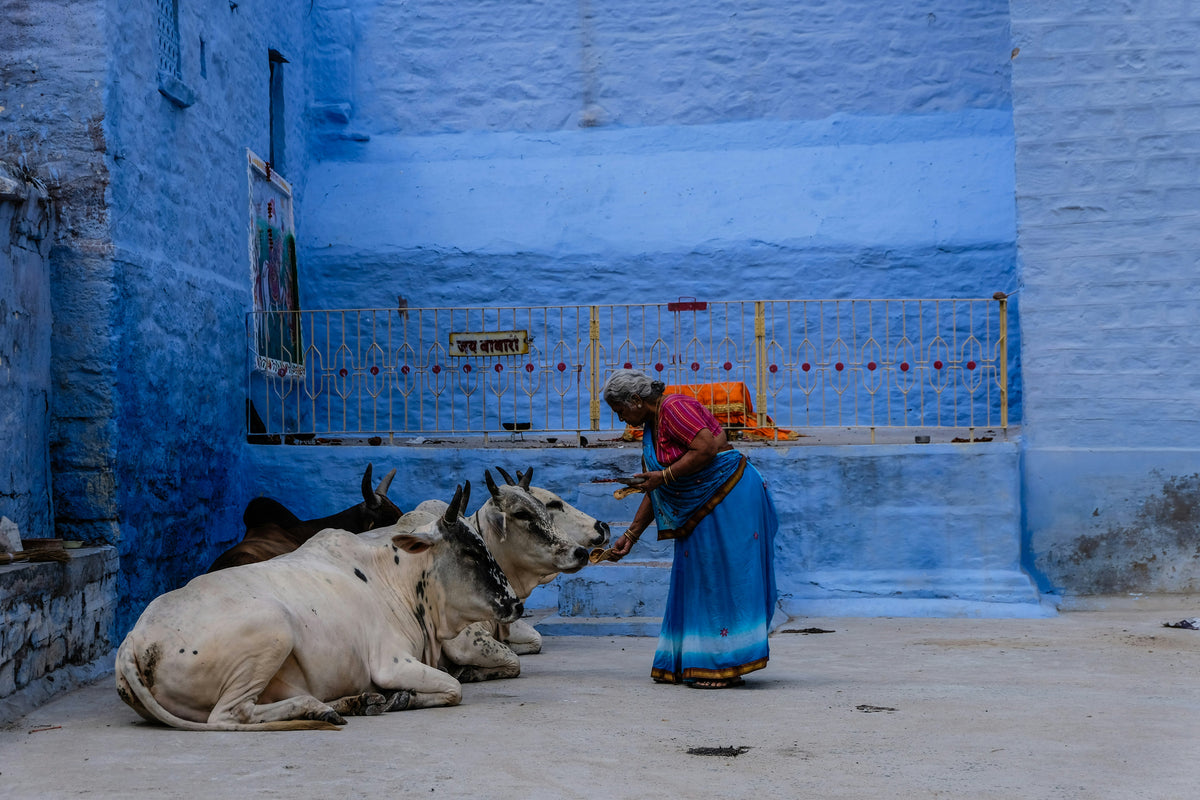
A cow resting beside a village road, a family offering food to cattle, or an image of Lord Krishna playing His flute among cows. These scenes may be familiar to anyone who has encountered Indian culture.
But they also raise a question: Why are cows considered sacred in India?
The answer involves much more than a single religious rule. Across centuries, cows have been associated with nourishment, agricultural life, motherhood, nonviolence, and devotion. Their significance is especially prominent in many Hindu traditions, although beliefs and practices differ among communities.
Understanding this reverence means looking at both religious ideas and the everyday relationships that helped shape them.
Why Are Cows Considered Sacred in Hinduism?
In many Hindu traditions, the cow represents generosity, nourishment, and the interdependence of living beings. One familiar expression is Gau Mata, meaning “Mother Cow.” The title reflects a comparison between a mother's nurturing role and the nourishment traditionally provided by cows through milk.
For many Hindus, this maternal symbolism encourages gratitude and respect. But it is important to distinguish reverence from the idea that every Hindu worships cows as gods. Some communities perform ceremonies honoring cows, while others express respect through dietary customs, religious teachings, or everyday practices. The cow may be regarded as sacred without being understood as a deity in the same sense as Vishnu, Shiva, or Devi.
Hinduism itself encompasses diverse philosophical schools, devotional traditions, and regional cultures. There is no single practice followed identically by all Hindus. The cow's special status is best understood through several overlapping ideas rather than one universal explanation.
The Cow as a Symbol of Nourishment and Nonviolence
One important concept is ahimsa, a Sanskrit term commonly translated as nonviolence or non-harming. In Hindu ethical thought, ahimsa encourages people to consider the suffering of other living beings and to avoid unnecessary harm. Its application varies. Some Hindus practice vegetarianism, others abstain specifically from beef, and others follow different dietary traditions. For those who regard the cow as especially worthy of protection, ahimsa offers an ethical foundation for treating animals with compassion.
The cow also has an established place in Hindu religious symbolism. In traditional households, milk and dairy products such as yogurt and ghee—clarified butter—have served both nutritional and ceremonial purposes. Ghee, for example, is used in certain offerings and sacred fire rituals.
The cow's association with nourishment has contributed to its maternal symbolism, while its role in religious ceremonies has reinforced its cultural importance.
Another figure associated with this symbolism is Kamadhenu, the extraordinary wish-fulfilling cow described in Hindu religious traditions. Often understood as a divine or celestial cow, Kamadhenu represents abundance and generosity.
These associations help explain why the cow can symbolize more than an agricultural animal. In religious art and storytelling, it may evoke the sustaining qualities of nature, the importance of gratitude, and the relationship between human life and other living beings.
Krishna and the Cows of Vrindavan
For followers of Lord Krishna, cows have an additional and deeply personal significance. In the sacred narratives of Krishna's childhood, He grows up among the cowherd families of Vrindavan, a region in northern India. He accompanies His friends into the pastures, plays His flute, and tends the cows alongside His brother Balarama. These activities are described in the Śrīmad-Bhāgavatam, an important scripture in Vaishnava traditions.
Krishna is known by several names that reflect this relationship. Gopala is associated with His role as a protector or caretaker of cows, while Govinda has traditional interpretations connecting Him with cows and the pleasure He gives them. Within Gaudiya Vaishnavism, Krishna's cowherding activities are understood as divine pastimes, not merely episodes of village life.
The affection between Krishna, His companions, and the cows of Vrindavan is part of the tradition's understanding of loving relationships with the Divine. This relationship is also remembered during Gopastami, a festival commemorating Krishna and Balarama's transition from tending calves to caring for grown cows.
To learn more about this celebration, explore our article, “What Is Gopastami? Krishna, Cows, and the Tradition of Cow Protection,” which explains its spiritual significance and traditional observances.
The Historical Importance of Cows in Indian Life
Religious symbolism is only part of the story. For generations, cattle played important roles in agricultural communities across the Indian subcontinent.
Cows supplied milk, which could be consumed directly or processed into yogurt, butter, and ghee. Oxen provided draft power for plowing fields, transporting goods, and performing other agricultural work. Cattle dung was also used as fertilizer and, when dried, as fuel. These contributions made cattle valuable to many rural households, particularly where agriculture depended heavily on animal labor.
Their importance was therefore both practical and cultural.
A family's relationship with its cattle could influence food production, household work, and economic stability. Over time, these experiences became intertwined with religious ideas about nourishment, gratitude, and protection. Yet the history of cattle in India should not be reduced to an unchanging picture of peaceful village life. Attitudes toward cattle, meat consumption, and animal sacrifice have varied across historical periods and religious communities. Scholars have examined how the cow's status developed through changing social, economic, and theological circumstances.
Modern India is equally diverse.
Mechanized agriculture has changed the role of draft animals in many areas, while dairy production remains economically important. Urbanization has also transformed the relationship between people and cattle. The historical importance of cows helps explain their cultural significance, but it does not mean that every Indian household today depends on cattle or follows the same religious customs.
Cow Protection and the Meaning of Go-Seva
In Vaishnava traditions, reverence for cows can take the form of go-seva, or service to cows. This may involve providing food, shelter, grooming, veterinary attention, and other forms of care. Some communities maintain goshalas, facilities where cattle are housed and looked after. Their purposes and operating conditions vary: some function as religious sanctuaries, while others are connected with dairy production, animal rescue, or agricultural work.
The distinction between religious ideals and actual animal welfare is important. Although cows are widely revered in India, that reverence does not guarantee that every animal receives adequate care. Abandoned cattle, limited shelter capacity, the costs of maintaining aging animals, and welfare concerns within dairy production are real challenges.
Recognizing these difficulties does not diminish the religious meaning of cow protection. Rather, it helps distinguish the ideal of compassionate treatment from the practical conditions needed to achieve it. For communities committed to go-seva, the religious principle must be expressed through the animals' actual well-being.
A Living Tradition at New Vrindaban, West Virginia
The cultural and religious significance of cows extends beyond India. In the hills of West Virginia, New Vrindaban offers an example of how Krishna-centered traditions have taken root in North America. Founded in 1968, the community was inspired by the teachings of A. C. Bhaktivedanta Swami Prabhupada, founder of the International Society for Krishna Consciousness (ISKCON). Its name reflects its spiritual connection with Vrindavan, India, and its religious life centers on devotion to Lord Krishna.
Cow protection became part of the community's work in 1969. Today, the New Vrindaban Goshala is an important expression of that tradition. According to the community's official description, its program includes caring for milking cows, calves, bulls, and older animals that no longer produce milk.
A central principle of the program is that care should continue throughout an animal's life, rather than depend only on its usefulness for milk or agricultural work.
The community also maintains a dairy tradition connected with temple worship, where milk is offered as part of devotional practice. For visitors, New Vrindaban provides an opportunity to encounter a religious tradition through more than books or images. The goshala connects the pastoral world described in Krishna's sacred narratives with the everyday activities of a contemporary devotional community. It also illustrates how cultural traditions can travel across continents while retaining their spiritual foundations.
Understanding the Sacred Cow Beyond the Stereotype
The expression “sacred cow” is widely recognized, but it can obscure as much as it explains. Cows hold a distinctive place in many Hindu traditions because of several interconnected factors: their historical contributions to agricultural life, their association with nourishment, their place in religious symbolism, and the ethical importance of compassion toward living beings.
For Krishna devotees, their significance is also rooted in the sacred narratives of Vrindavan.
These meanings have developed across different times and communities. They should not be mistaken for a single belief shared uniformly by everyone in India. Understanding why cows are sacred requires recognizing both the ideals expressed through religious traditions and the complexities of human relationships with animals.
Seen in that broader context, reverence for the cow is not simply an unusual cultural custom. It is one way that many Hindu communities have expressed their understanding of nourishment, gratitude, religious devotion, and the responsibilities that accompany human life.
Explore Our Cow-Themed Collection
For readers interested in the cultural and devotional imagery associated with cows, Matchless Gifts, the New Vrindaban Gift Shop, offers a selection of cow-themed devotional and decorative items.
Explore our cow-themed collection and enjoy 15% off products in the collection for a limited time. The discount is already applied automatically, so no coupon code is required.