
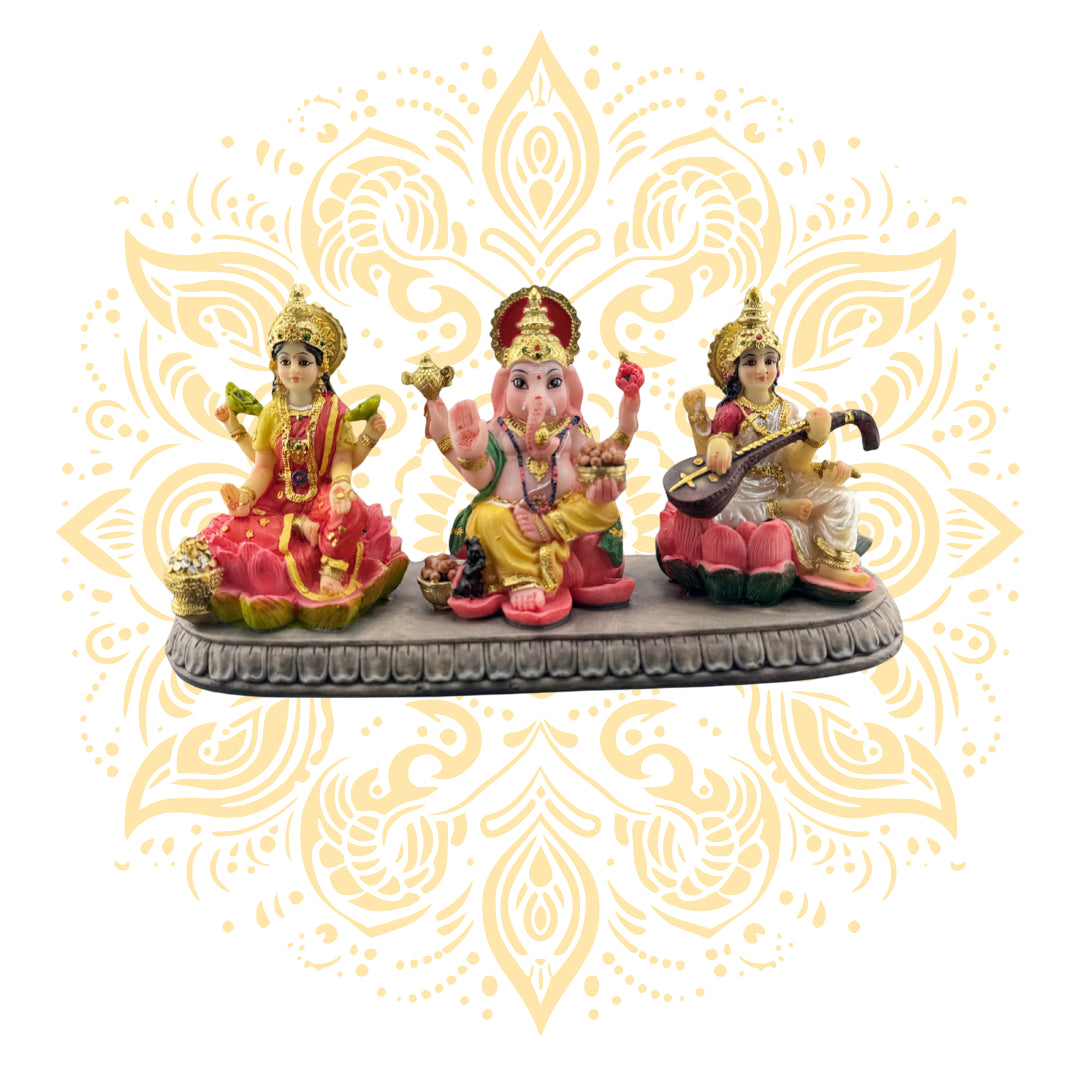
A figure of Lakshmi, a small statue of Ganesh, and an image of Saraswati might seem to represent three separate wishes: prosperity, success, and knowledge.
But when these deities appear together, the arrangement invites a more interesting question. What is the value of prosperity without the wisdom to use it? And how do we begin something worthwhile without considering the obstacles ahead?
These questions help explain why Lakshmi, Ganesh, and Saraswati are sometimes honored together during Diwali.
Their association brings several important ideas into conversation: abundance, discernment, learning, and auspicious beginnings. Yet their presence together is not a universal Diwali custom. Hindu communities celebrate the festival in different ways, and each deity has a significance that extends well beyond this particular occasion.
To understand their connection, it helps to begin with the deity most closely associated with Diwali in many Hindu households: Lakshmi.
Lakshmi: Prosperity and Auspiciousness
Preparing a home for Diwali can involve quite a bit of work. Floors are cleaned, entrances decorated, lamps arranged, and spaces set aside for worship. In many households, these preparations are closely connected with Lakshmi Puja.
Lakshmi is widely revered as the goddess of prosperity, good fortune, beauty, and auspiciousness. In Vaishnava traditions, she is also understood as the divine consort of Vishnu, with a theological significance extending far beyond material wealth.
During Diwali, families who observe Lakshmi Puja may offer prayers, flowers, lamps, and other items as part of their worship. The occasion is especially important in some business and trading communities, where the festival also marks the transition into a new accounting year.
It is easy to understand why Lakshmi is associated with wealth. But reducing her significance to money leaves out much of the religious picture.
The Sanskrit term śrī, closely associated with Lakshmi, conveys ideas of auspiciousness, splendor, and prosperity. In devotional life, these qualities may be understood in relation to well-being, divine grace, and the flourishing of a household.
For many worshippers, seeking Lakshmi's blessings is therefore connected with the hope for a stable and auspicious life, not simply the accumulation of possessions.
And prosperity, however welcome, brings its own questions. A new business, a new home, or a new responsibility may offer opportunities, but each also comes with uncertainties.
That is where Ganesh enters the picture.
Ganesh: The Wisdom to Begin Well
Ganesh is among the most recognizable deities in Hindu traditions. With his elephant head and distinctive form, he is especially associated with removing obstacles and blessing auspicious beginnings.
He is frequently honored before important undertakings, including religious ceremonies, journeys, and new ventures.
This makes his association with Diwali understandable, particularly in households where the festival also marks a fresh start.
During many Lakshmi Puja observances, Ganesh is worshipped alongside Lakshmi. Their presence together connects the hope for prosperity with the desire to overcome difficulties and begin on an auspicious note.
Ganesh is also associated with intelligence and discernment. His significance is therefore not limited to the expectation that difficulties will simply disappear.
Beginning something worthwhile often requires recognizing the obstacles involved. A family opening a business, for example, must consider decisions, responsibilities, and the uncertainties that come with a new venture.
Within devotional practice, seeking Ganesh's blessings expresses reverence and the hope for a favorable beginning. It is not a guarantee that every undertaking will succeed.
Placed beside Lakshmi, Ganesh adds another dimension to the idea of prosperity. Good fortune may create opportunities, but those opportunities still call for judgment.
That connection leads naturally to Saraswati, whose significance centers on knowledge itself.
Saraswati: Knowledge, Learning, and the Arts
Saraswati is revered as the goddess of knowledge, learning, speech, music, and the arts.
In traditional representations, she is often depicted holding a veena, a stringed musical instrument, and is associated with the pursuit of understanding and refined expression.
Her significance is familiar in settings where learning matters: classrooms, music lessons, the study of sacred texts, and the work of teachers, writers, and artists.
Saraswati's worship has particularly important associations with festivals such as Vasant Panchami, as well as regional traditions honoring education and the arts.
Her relationship with Diwali is more specific than Lakshmi's.
Not every Hindu household includes Saraswati in Diwali worship, and the presence of all three deities together should not be presented as a universal religious requirement.
In certain communities, however, Saraswati is honored during observances connected with the beginning of a new business or accounting year.
This connection becomes especially interesting when we consider what an account book represents.
A ledger may record earnings and expenses, but keeping it properly also requires attention, knowledge, and responsibility. Prosperity and learning are not competing concerns. In the context of these observances, they can be understood as complementary.
Saraswati's presence brings that relationship into focus.
Why Are the Three Deities Honored Together?
One of the clearest examples of how these associations come together is Chopda Puja, also written Chopda Pujan, an observance particularly associated with Gujarati trading and business communities.
The word chopda refers to account books or ledgers. During Diwali, participating families and businesses may close their previous accounts and ceremonially honor the books intended for the new accounting year.
Traditionally, these might be bound paper ledgers. Today, some families and businesses also include computers or digital accounting tools in the observance.
Lakshmi and Ganesh are important figures in many forms of Chopda Puja. Saraswati, also known as Sharada, is associated with knowledge and learning and is honored in related observances in some communities.
The combination brings three concerns into the same setting: prosperity, an auspicious beginning, and the knowledge needed to conduct one's affairs.
There is something distinctive about honoring an account book during a religious festival. An object used for ordinary financial records becomes part of a ceremony marking the transition from one period of work to another.
The practice also illustrates how religious observance can be woven into everyday responsibilities.
Still, Chopda Puja is not performed identically by every family, nor does every version involve the same combination of deities.
Lakshmi and Ganesh are a familiar pairing during Diwali in many Hindu communities. Saraswati may be included according to particular regional, family, or devotional traditions.
When all three are represented together, their association can encourage reflection on the relationship between material well-being, sound judgment, and knowledge.
That is a way of interpreting their combined symbolism, not a universal scriptural instruction or a promise of particular results.
What Is a Murti, and How Is It Used at Home?
During Diwali, devotional images may be placed in a designated area of the home, sometimes alongside flowers, lamps, and other items used in worship.
A sacred representation of a deity is commonly called a murti (Sanskrit: mūrti).
For readers unfamiliar with Hindu devotional practices, it is helpful to understand that a murti may have a role quite different from that of an ordinary decorative object.
Depending on the tradition and the circumstances of worship, it can serve as a focus of devotion through which practitioners honor and relate to the Divine.
Many Hindu homes have a designated place for prayer or puja. It might be a separate room, a cabinet, or a small altar maintained as part of household religious life.
Images and murtis may be placed there, sometimes accompanied by lamps, flowers, or food offerings. The particular practices depend on the family's tradition.
Some households follow daily forms of worship. Others emphasize festivals and special occasions. Formal temple worship and domestic devotional practices may also have different requirements.
For someone selecting a murti for a home altar, it is worth considering the religious customs of the household, the available space, and how the image will be used.
The same care applies when choosing one as a gift. A devotional figure can be meaningful when it reflects the recipient's beliefs and preferences.
Its value should not be confused with a guarantee of prosperity, protection, or success. The religious significance lies in the tradition and devotional relationship surrounding the image.
Two Representations of Lakshmi, Ganesh, and Saraswati
Representations of Lakshmi, Ganesh, and Saraswati can take different artistic forms, reflecting the rich visual traditions associated with these deities.
For a home altar or devotional display, the choice of a murti may depend on the customs of the household, the available space, and personal preferences.
Matchless Gifts offers two representations featuring all three deities together.
The Lakshmi, Saraswati, and Ganesh Diwali Murti brings the three deities together in a single composition, offering a unified representation for a home altar or devotional display.
The Ganesh, Lakshmi, and Saraswati Three-Piece Murti Set also presents the three deities together in a unified arrangement, offering another option for a home altar or devotional display.
For someone exploring these representations, understanding the deities' significance is a useful starting point. It gives the arrangement meaning beyond its appearance.
A Festival of Prosperity, Knowledge, and New Beginnings
Diwali brings together a remarkable variety of religious and cultural customs. In some homes, Lakshmi Puja is central. In others, different deities, narratives, and observances shape the celebration.
The lighting of lamps is among the festival's most recognizable practices. Our article, Why Is Diwali Called the Festival of Lights?, explores the different meanings associated with that tradition.
When Lakshmi, Ganesh, and Saraswati are honored together, their presence offers another perspective on Diwali.
Lakshmi's association with prosperity, Ganesh's connection with auspicious beginnings, and Saraswati's relationship with knowledge bring different concerns into the same devotional setting.
A new year of work may begin with hopes for prosperity. It will also involve decisions, difficulties, and things yet to be learned.
That is what makes the three-deity arrangement worth understanding. It brings together aspirations that are often considered separately, while leaving room for the particular beliefs and practices of the people who honor them.
The figures do not need to appear in every Diwali household for their association to be meaningful. Their presence together invites a question that remains relevant long after the festival lamps have been put away: what does it take to make good use of the opportunities we receive?