
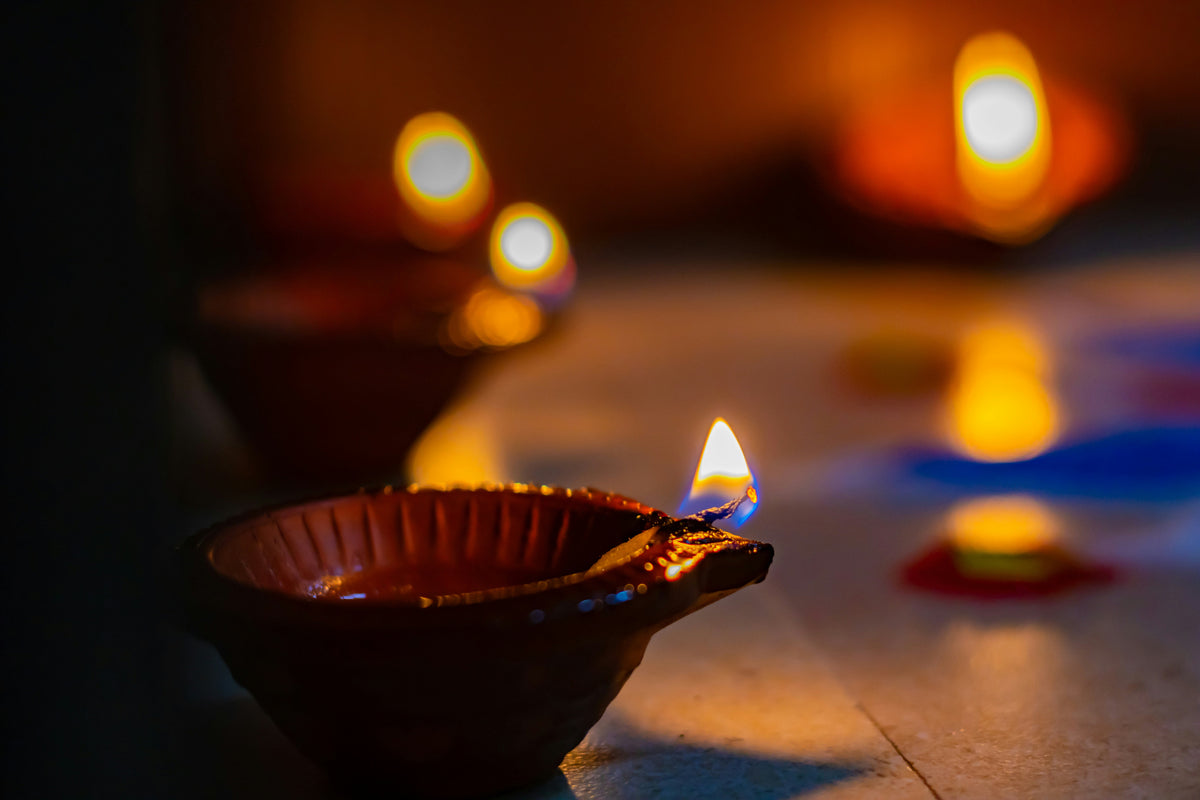
A small clay lamp is not an especially complicated object. It needs a little oil or ghee, a cotton wick, and a flame.
Yet during Diwali, millions of these lamps help transform homes, courtyards, temples, and streets into places of celebration. They appear along windowsills, beside doorways, and in carefully arranged rows. Electric lights often join them, illuminating buildings and public spaces.
The sight is so closely associated with Diwali that the festival is known around the world as the Festival of Lights.
But the name is not simply a description of the decorations. Behind the lamps are stories of homecoming, devotion, liberation, and the relationship between light and knowledge.
And not everyone who lights a lamp during Diwali is remembering the same story.
The Meaning Is in the Name
The name Diwali comes from Deepavali, derived from Sanskrit words meaning a lamp and a row or series. The familiar interpretation is “a row of lights.”
It is a remarkably literal name for a festival with such a wide range of religious meanings.
Traditional lamps, called diyas, are often made from clay and filled with oil or ghee. A cotton wick draws the fuel toward the flame. During Diwali, families may place them at entrances, on balconies, around courtyards, or near places of worship.
Lighting a darkened space changes its appearance immediately. In many Hindu interpretations, the act also expresses a spiritual idea: the movement from ignorance toward knowledge, from wrongdoing toward righteousness, or from darkness toward divine illumination.
To understand why these meanings matter, we need to look beyond the lamps themselves and consider the stories people associate with them.
The Lamps That Welcomed Rama Home
One of the best-known stories associated with Diwali comes from the Hindu epic Ramayana.
According to the Ramayana, Prince Rama spends fourteen years in exile from Ayodhya. His wife, Sita, and his brother Lakshmana accompany him into the forest. During their exile, Sita is abducted by Ravana, the ruler of Lanka.
Rama ultimately defeats Ravana and returns with Sita and Lakshmana.
In a widely told Diwali tradition, the people of Ayodhya celebrate Rama's homecoming by illuminating the city with lamps.
The image is easy to understand: a kingdom welcoming its returning prince with light.
For devotees of Rama, however, the story carries a significance beyond a royal homecoming. Rama is revered as an incarnation of Vishnu, and his life is associated with dharma, a Sanskrit term encompassing duty, righteousness, and the principles that sustain moral and cosmic order.
The illuminated city becomes an expression of joy at his return and, in devotional interpretation, the restoration of righteous rule.
This is one of the most familiar explanations for Diwali's lamps, particularly in parts of northern India.
Elsewhere, the same festival season brings different stories into focus.
Light, Prosperity, and the Defeat of Narakasura
In many Hindu households, Diwali is closely associated with Lakshmi, the goddess of prosperity, good fortune, and auspiciousness.
During Lakshmi Puja, families may clean and decorate their homes, illuminate entrances, and offer prayers. The lights help create an atmosphere of welcome and reverence.
Prosperity in this setting can encompass household well-being and good fortune as well as material wealth. The observance expresses hopes for an auspicious future while honoring the goddess.
In parts of southern India, another episode receives particular attention: Krishna's defeat of Narakasura.
The occasion is associated with Naraka Chaturdashi, which many communities observe as an important part of the Diwali period. Traditional accounts describe Krishna's victory over Narakasura, although details of the narrative vary among texts and regional traditions.
For those celebrating the occasion, the defeat represents the overcoming of destructive forces. Customs may include early-morning oil baths, new clothing, festive foods, and family gatherings.
These observances illustrate why Diwali cannot be explained through a single story.
In one household, lamps may evoke Rama's return. In another, worship of Lakshmi is central. Elsewhere, Krishna's victory or the beginning of a new year shapes the festivities.
The calendar brings these traditions into proximity, but their meanings remain distinct.
Why a Lamp Is More Than a Decoration
The diya offers a useful way to understand how a physical object can carry several meanings.
In Hindu worship, lamps are used throughout the year, not only during Diwali. During arati, light may be offered before a deity as an expression of reverence.
At home, a lamp can also mark a welcoming entrance or contribute to the festive atmosphere. Religious and social purposes sometimes overlap, but they should not be treated as identical.
Lighting a traditional diya involves a series of small actions: preparing the wick, adding fuel, and tending the flame. For families who observe the custom, these acts can become part of the festival's familiar rhythm.
Electric lights have expanded the possibilities for Diwali decorations, from modest household displays to elaborate public illuminations. The clay lamp nevertheless remains one of the festival's most recognizable symbols.
Its simplicity makes it easy to recognize. Its meaning depends on the tradition in which it is used.
That distinction becomes especially important when we consider celebrations beyond Hindu communities.
What Does Light Symbolize During Diwali?
The phrase “light triumphs over darkness” is often used to summarize Diwali. It captures an important theme, but it cannot explain every observance on its own.
In traditions surrounding Rama's return, illumination expresses welcome, joy, and the restoration of righteous order.
During Lakshmi Puja, light contributes to an atmosphere of auspiciousness and devotion.
In Jain tradition, lamps recall the spiritual knowledge associated with Mahavira's liberation.
During Bandi Chhor Divas, festive illumination accompanies the remembrance of Guru Hargobind's release and the freedom of others.
These meanings share certain themes, yet each belongs to a particular religious understanding.
That diversity is one reason Diwali rewards a closer look. The lamps are immediately recognizable, while the stories behind them invite further discovery.
How Light Becomes a Shared Celebration
Religious narratives help explain why Diwali matters. Everyday customs show how people celebrate it.
Families may decorate entrances with rangoli, illuminate their homes, gather for prayers, wear festive clothing, and visit relatives or friends. The details differ considerably among households and communities.
At New Vrindaban, sharing food offered in devotion is also part of the community's spiritual life. For those wishing to share something special this Diwali, the Diwali Mahaprasad Sweets Gift Box brings that tradition into a gift meant to be enjoyed and shared.
Food is another important part of many celebrations. Traditional sweets are prepared and exchanged, extending the festivities beyond the people gathered in one home. Our companion article, Why Do We Share Sweets During Diwali?, explores the cultural and devotional meanings of that custom.
Together, these practices make the festival visible in ordinary spaces.
A lamp is placed near a doorway. A family gathers for worship. Someone visits a neighbor. A home becomes a place where religious traditions and social relationships meet.
The small clay diya from the beginning of our story remains a simple object: a wick, a little fuel, and a flame.
But knowing why it has been lit changes what we see.
A row of lamps may mark a homecoming, accompany an offering, or recall a spiritual teacher or an act of liberation. The Festival of Lights is therefore an unusually fitting name. It describes what is visible while leaving room for the many stories that give the lights their meaning.
Featured image: Photo by VD Photography on Unsplash.